The Electoral College Debate

As Election Day was almost a month ago, many Americans are reflecting on the electoral process in the United States, specifically whether or not there is still a need for the Electoral College. 

Every four years, millions of Americans wonder why the president is chosen through the Electoral College. Many believe that a system that allows the loser of the national popular vote to become president is outdated and needs to be changed. 

The Electoral College also narrows the campaign for president to mostly swing states. Today, 48 states use a winner-take-all system in which the candidate that receives the most votes in the state gets the states electoral votes. Most states are considered either solidly Democrat or solidly Republican. Candidates then do not feel the need to campaign in these states since either themselves or their opponent will easily take the state. The states that matter to the candidates are battleground states. States such as Pennsylvania, Michigan, Wisconsin, Arizona, Florida and North Carolina are considered battlegrounds. In the height of a presidential election, candidates focus on getting the most votes out of these states. 

A little more than half of Americans prefer a national popular vote to elect the President of the United States. Congress has attempted on many occasions to alter or get rid of the electoral college completely. In 1970, Congress came close to changing the electoral system in the United States but it did not have quite enough support. 

According to a Gallup poll conducted in September 2020, 61% of Americans support changing the Constitution to elect the president using a national popular vote. Americans are very split on how to elect the president. There is a party divide in changing to a national popular vote, 89% of Democrats support a popular vote, while only 23% of Republicans do. 

The Electoral College is made up of 538 delegates who select the president after the election is certified in each of the 50 states. They cast the vote for president and formally elect the president of the United States. The total number of electors represent the total number of U.S. senators (100), the total number of state representatives, (435), and three more electors from D.C.

Each state in the U.S. receives the same number of electors for its two senators. Meaning that California, the state with the largest population, receives the same amount of electors as Wyoming, the state with the smallest population. Smaller states receive more electors based on their population than larger states. 

It takes 270 or more electoral votes to win a presidential election. On Election Day, many of the media outlets have “270 to win” on their electronic boards depicting the states. 

In 2016, Trump won the election with 304 electoral votes, but lost the popular vote by almost three million votes. This also occurred in 2000, when Al Gore won the popular vote but George W. Bush won the Electoral College. In only one presidential election since 1992 has a Republican candidate received more of the popular vote than the Democratic candidate. 

When the Constitution was written in the 1700’s, most Americans were not educated, were not allowed to vote, or were unable to learn about the candidates who were running for office. The founders could not trust the average voter to make the decision to choose the president, so the Electoral College was created. Americans are much more informed now, and have ways to become educated on the issues driving presidential campaigns. The Electoral College system is becoming more and more outdated. 

Supporters of the Electoral College say that smaller states will be overpowered by larger states in electing the president. Republicans are less supportive for getting rid of the Electoral College than Democrats and Independents. The divide between Republicans and Democrats has become greater since the 2016 election. After Trump defeated Clinton by getting more electoral votes, Democrats were more than four times as likely as Republicans to favor using the national popular. 

In order to amend the Constitution to abolish the Electoral College system in the U.S. there would support from two-thirds of the House of Representatives and the Senate, and three-quarters of the 50 states. There is deep partisanship regarding this issue, which means that it is unlikely to be resolved anytime soon.


What to do About Thanksgiving During a Pandemic

Photo by Karolina Grabowska on Pexels.com

As Thanksgiving is a week away, and Christmas is around the corner, Americans have to make the difficult decision of how to spend the holiday, while also following COVID-19 guidelines.

How can you talk to your loved ones about your Thanksgiving plans to be safe, while also avoiding hurting their feelings? New York Governor Andrew Cuomo put it very simply: “You don’t want to be the turkey on Thanksgiving,” Cuomo said. “You know what love is on Thanksgiving? I love you so much and I’m so thankful for you that I’m not going to see you. That’s how you show me you love me. I’m not going to see you – that’s how much I love you.” 

New York state also implemented a restriction to not allow more than 10 people in a private household. The governor is discouraging any large family gatherings for Thanksgiving this year. 

New Jersey Governor Phil Murphy also implemented the 10 person limit in households for the Thanksgiving holiday. Cases have risen across the state over the last month, but there have especially been increases over the last week. On Wednesday, there were 4,063 Coronavirus cases in New Jersey. The seven-day average for new positive cases in New Jersey is now 3,744. This is the highest since the outbreak began in the spring. 

Both Governor Murphy and Governor Cuomo predict that Coronavirus cases could spike after the Thanksgiving holiday in both states. Cuomo described the latest spread of the Coronavirus in New York as spread in households from gatherings. Cuomo stated on Wednesday, “This living room spread is the new problem and it will go up after Thanksgiving and you will see orange zones and increased positivity after Thanksgiving. I’ll wager you on it today and you’re going to see more dramatic action.” 

Experts say to avoid gathering with anyone who does not live in your household for Thanksgiving. If you have to travel for Thanksgiving, it is important to quarantine for two weeks prior to when you will be seeing your family members. 

Aside from quarantining, testing negative for the Coronavirus before arriving at your destination is also important. But, experts say, a negative COVID-19 test is only a “snapshot in time.” If one tests negative before leaving their home, they can become exposed to the Coronavirus on the way to the destination. Travel at off peak times and travel alone if possible to limit the exposure to the virus while traveling to the destination. 

If you are hosting a Thanksgiving gathering, keep the group of people small, try to have the dinner outside if weather permits, have hand sanitizer and cleaning supplies, and think about the risks of having the gathering. Is there anyone in the gathering who may be high risk? Is there anyone attending the gathering who may have been exposed to the Coronavirus without knowing? Keep the risks in mind and see if it is actually safe to have these people in your home. 

Overall, it will be difficult this year to keep the family gatherings small, or not have them at all. Talking to loved ones about the risks of a large Thanksgiving dinner, will be difficult, but are necessary in order to protect families and keep infection rates of the Coronavirus from continuing to rise. If Americans keep their gatherings small this year, by next year, hopefully families will be able to gather again to celebrate the holidays.

Will a Majority of Americans Take a Coronavirus Vaccine?

Photo by Anna Tarazevich on Pexels.com

As Coronavirus cases climb in the United States to record highs, and a vaccine on the horizon, how likely are most Americans to be willing to take the vaccine when it is available?

Coronavirus cases have skyrocketed the last month, and reached a new record of 11 million total cases in the United States. On November 17, the 7-day average in the United States was 158, 265 total positive cases. 

On Wednesday, Pfizer announced that the coronavirus vaccine was 95% effective and did not have any serious side effects. Pfizer and it’s partner BioNTech, plan to apply to the FDA within a few days for emergency authorization of the vaccine. Pfizer could have up to 50 million doses available to Americans by the end of the year, and up to 1.3 billion by the end of next year. 

On Monday of this week, another company Moderna had announced that it’s Coronavirus vaccine was 94.5% effective in early analysis. Moderna also plans to ask the FDA for emergency authorization. There are two potential Coronavirus vaccines that could be available by the end of the year. 

With these new vaccine announcements from two different companies, are Americans willing to get vaccinated and trust a vaccine will be safe?

According to a poll from Gallup released on Tuesday, many Americans still are not sure about the safety of a vaccine. The poll showed that 58% of Americans are willing to be vaccinated when a safe, FDA approved Coronavirus vaccine is available. This number of willing Americans has increased from 50% when the same question was asked in September. Earlier in the pandemic, the number of Americans willing to take a Coronavirus vaccine when it becomes available was much higher. In June in the Gallup poll, 66% of Americans said they would be vaccinated once the vaccine was available. 

The Gallup survey was conducted between October 19 and November 1. This poll was conducted before Pfizer and Moderna announced their vaccines’ effectiveness, but as cases are continuing to rise across the United States. Americans may have been more willing to take the vaccine since cases are rising in almost every state in the country. 

The increased willingness to take a coronavirus vaccine when it becomes available was greater in several different categories of Americans. Democrats and Americans between the ages of 45 and 64 all increased in their willingness to take the vaccine. Among Democrats, willingness to take a vaccine increased to 69% from 53% in September. 49% of Americans between the ages of 45 and 64, said they were willing to take a Coronavirus vaccine when it becomes available. This is an increase from 36% in September. 

The 42% of US adults who said they would not get a vaccine is down from 50% in September. Despite the decrease in Americans who would not get a vaccine, it still proves that it will be difficult to get cooperation from all Americans. In order to combat the Coronavirus in the United States, the majority of Americans need to get vaccinated. 

Of those 42% of Americans who are not currently willing to be vaccinated for the Coronavirus, 37% responded that they were concerned about the vaccine being rushed, 26% responded they would want to wait to confirm it is safe before taking it, and 12% do not trust vaccines generally. These were the most common reasons for not wanting to receive the vaccine. 

Similar results were found in a recent poll from Suffolk University. Respondents were asked if they will take a vaccine as soon as they can, wait a while until others have taken it, or not take the vaccine at all. Of those surveyed, 26% said they would take it as soon as they can, 47% said they would wait until others have taken it, and 20% will not take a vaccine. 

Americans overall are less likely than they were earlier this year and at the beginning of the pandemic to say they would get vaccinated for the Coronavirus when a vaccine becomes available. Public health officials will face a challenge in encouraging all Americans to get vaccinated, when about 40% are still refusing. 

Public health officials may be able to convince those that are concerned about the vaccine being rushed, or want to wait to know that it is safe, by continuing with clinical testing. The results that the Moderna and Pfizer vaccines are 95% effective may also be able to convince those who are hesitant. Convincing the 12% of Americans who usually distrust vaccinations to get vaccinated for Coronavirus will be much more challenging.

The Unfinished Battle for the Senate

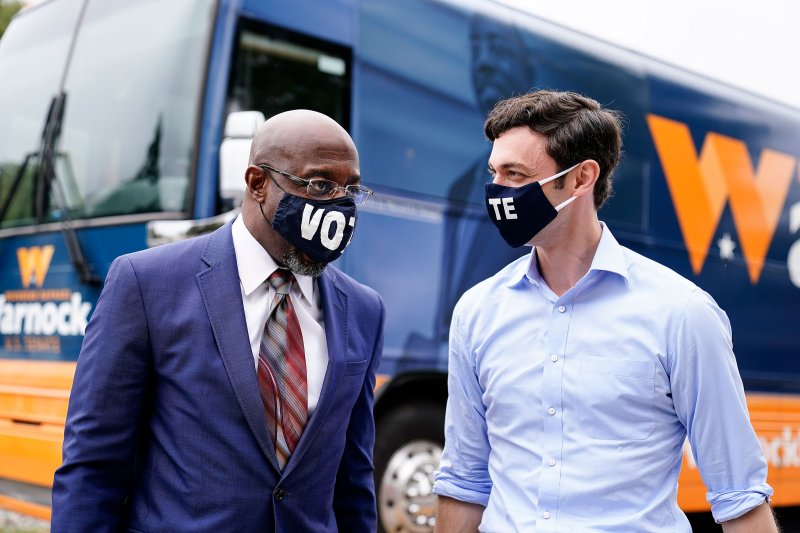
(AP Photo/Brynn Anderson)

Election Day 2020 is over and the outcome of the presidential race has been decided, but the Senate is still up for grabs. 

As of Thursday at 9 pm, Democrats have 48 seats in the Senate, and Republicans have 50. Cal Cunningham conceded earlier in the week to Thom Tillis, ending the North Carolina Senate race. Cunningham came within two points of unseating Tillis. Incumbent, Dan Sullivan, defeated Al Gross in Alaska earlier in the week. The outcome of the Senate will come down to two seats in Georgia headed for a runoff. 

What is a runoff race? According to Ballotpedia, a runoff election is a second election held to determine the winner when no candidate in the first election meets the vote count to win the race. In Georgia, both Senate races will be determined by the outcome of the runoff election in January, since no candidate in either race received 50% of the vote. 

Why does Georgia have this runoff system in the Senate? Historians say that it was created to make it harder for the preferred candidates of Black voters in Georgia to win during the Jim Crow era. According to Vox News, in 1963, Denmark Groover proposed the runoff election system in state, local, and federal offices. By having a runoff, Black voters in Georgia would no longer be able to vote overwhelmingly for one candidate, while the white voters in the state would split their votes among many candidates. This way, the top candidate that was backed by white voters, and the candidate that was supported by Black voters, would be in a runoff election and the white voters’ candidate would be more likely to win. 

On Election Day, in the special election, Democrat Rapheal Warnock, received 32.9% of the vote, while Republican Kelly Loeffler Received 25.9%. In the regularly scheduled election, Republican Senator, David Perdue received 49.7% of the vote, while Democrat Jon Ossoff received 48%. 

If Democrats manage to win both seats, the party would take control of the Senate after Inauguration Day. With a tie in the Senate at 50/50, Vice President Kamala Harris would be the tie breaker in votes. It would be significantly easier for President Biden to get his agenda through Congress, with that incredibly slim majority. 

Up until recently, it seemed unlikely that the Democrats would be able to flip both of these seats, given that Georgia was a seemingly red state. Runoff elections in the state usually go to Republican candidates. But, the state appears to be changing and grassroots activists such as Stacey Abrams, and the work of her organization, Fair Fight, are mobilizing Black voters in the Georgia. Abrams increased voter registration and voter turnout in the 2018 and 2020 elections. President-elect Joe Biden is also likely to become the first Democrat to carry the state of Georgia since 1992, after gaining 14,000 more votes than President Trump. A state that was once extremely red, now seems to be more purple. 

Georgia has also never seen a runoff election like this one. Two extremely high profile races are on the ballot, and control of the Senate is on the line. Georgia will be the center of national attention until January 5th. Both parties will spend enormous amounts of money in advertising and on the ground campaigning. With this much national attention, voter turnout could increase vastly across the state. This is also the first time a Black candidate has been on the ballot for a Senate runoff, which could turn out more black voters. Democrats see the momentum from Election Day and want to keep it going. 

Georgia has not elected a Democratic senator in 20 years. But, Democrats have many reasons to be hopeful that the outcome of the Senate will end in their favor in Georgia, because of Biden’s victory in the state, and the newly registered voters.

Jaime Harrison’s Senate Campaign in South Carolina

“Tori Taylor and Jaime Harrison”​ by Third Way is licensed under CC BY-NC-ND 2.0

Republican incumbent Senator, Lindsey Graham, defeated Democratic challenger, Jaime Harrison in the South Carolina Senate race on Tuesday night. 

This ended one of the most intensely watched Senate races in the 2020 election. The race was also one of the most expensive congressional races in history, as Harrison raised 57 million dollars during the final full quarter of the campaign. The national attention that Harrison created, showed what is possible for a democratic candidate in not only South Carolina, but in the south as a whole. 

According to the results on Election Day reported by The New York Times, Graham won the South Carolina Senate race with 54.5 percent of the vote. Harrison received 44.2 percent of the vote, which was about a 5 point increase from Democrat Brad Hutto’s race against Graham in 2014.

In January, there was little belief in South Carolina that Harrison would be able to unseat Graham. Harrison ran his campaign to mobilize the Black voters in South Carolina and inspire the white voters. 

The race appeared to tighten in the fall. The Trump administration’s response to the coronavirus crisis made Harrison’s arguments that Graham followed the president too closely, became even more clear. Thousands of South Carolina residents had died from the Coronavirus this year. Harrison emphasized during the campaign Graham’s lack of response to the pandemic and lack of effort to help the residents of South Carolina. Instead of passing a second coronavirus-relief bill in the Senate, the Senate Judiciary Committee led by Graham, confirmed Amy Coney Barrett to the Supreme Court. 

During multiple appearances on Fox News, Graham practically begged viewers to make donations to his campaign. This gave Democrats the impression that victory in South Carolina was possible. 

Harrison spent $34 million of his third quarter donations on TV ads alone. Eight million went to digital advertising, and 2.2 million went to radio ads that targeted Black voters in South Carolina. Harrison had the funds to have one of the most robust ground operations in South Carolina that Democrats had seen in a long time. As the race tightened, it seemed that Harrison may had a chance to flip a seat once held by segregationist Strom Thurmond. 

Out of state money from both parties was put into the state as Election Day approached. The GOP-aligned Senate Leadership Fund spent about $16 million in South Carolina for Graham. The Democratic Senate Majority PAC spent about $6 million in advertising at the end of September. 

Despite Harrison’s loss, the work that the campaign did in South Carolina was able to register and mobilize Black voters across the state. Harrison gave the race national attention and encouraged participation of all Democrats in South Carolina.

Harrison was optimistic in a speech after the race was called. During his speech, Harrison told the crowd, “Well folks, I’m still breathing, and I still have hope. We proved that a new South is rising. Tonight only slowed us down. But a new South with leaders that reflect the community and serve the interests of everyone will be here soon enough.”

Stacey Abrams’ Fight in Georgia

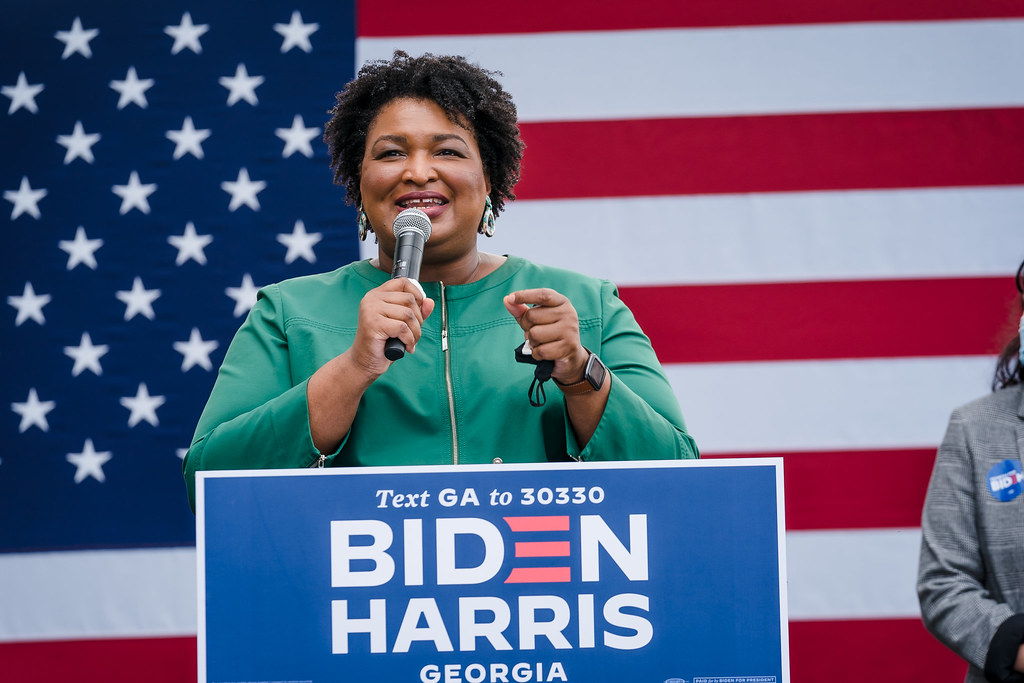
“Event with Stacey Abrams – Atlanta, GA – October 12, 2020” byBiden For President is licensed under CC BY-NC-SA 2.0

Georgia is increasingly becoming a swing state thanks to the work that former gubernatorial candidate, Stacey Abrams, has done in the state. 

As the counting continues in Georgia, as of Thursday night, former Vice President Joe Biden is narrowing in on President Trump’s lead. As of 8 pm eastern, a little less than 4,000 votes separate the two candidates. A democratic candidate has not won the state of Georgia since Bill Clinton. 

Two senate seats were also up for grabs in Georgia. Republican Senator, David Perdue, dropped below 50%, against Democratic challenger, Jon Ossof, Wednesday afternoon. If Perdue does not have 50% when all the votes are counted, Ossof and Perdue would compete in a runoff in January. In the other Senate race, Republican Senator Kelly Loeffler and Democratic challenger, Rev. Raphael Warnock are already scheduled for a runoff since no candidate received 50% of the vote

The results seem to conclude that Republicans can no longer count on Georgia to safely remain red in presidential, and congressional races. The state is trending blue, and is now arguably purple. The changing demographics in Georgia can contribute to the states’ changing political nature, but progressive activists, such as Stacey Abrams, have also helped the state change. 

Abrams founded The New Georgia Project in 2013. This project focused on registering minority voters. During 2018, when she was the first Black woman to run for governor in Georgia, Abrams created a strategy to increase voter turnout among groups from minority communities. 

Abrams lost the governor’s race by only 1.5% of the vote to Republican, Brian Kemp. Abrams refused to concede in that election. She accused Kemp, who was the Secretary of the State at the time and oversaw the results of the election, of creating voter suppression. She claimed that the state of Georgia failed it’s voters. 

Abrams founded Fair Fight after her loss of the governor’s race. This group had the goal of registering minority and young voters and fighting voter suppression in Georgia.  

In November 2018, Fair Fight filed a lawsuit in the federal court against the Georgia Secretary of State’s Office, and Georgia Board of Elections. Abrams challenged the mismanagement of the 2018 election that discouraged voters and created suppression. Fair fight also works to to create grassroots activists and strengthen voting rights

Her work continued during the 2020 election. Abrams and the team at Fair Fight registered about 800,000 voters since 2018. The team also ended voter suppression policies such as matching signature laws, which had required registrations to precisely match voters’ licenses down to the hyphen, or else risk being tossed out. 

Abrams said to NPR on November 2, “45% of those new voters are under the age of 30. 49% are people of color. And all 800,000 came on the rolls after November ’18, which means these are voters who weren’t eligible to vote for me but are eligible to participate in this upcoming election.”

These new voters that have been added to Georgia have brought the state onto the brink of becoming blue.

Why Are We Still Talking About Female Candidate Likability?

Processed with VSCO with c1 preset

A record number of women announced that they were running for president in 2020. Yet, these incredibly qualified women face a different set of standards than their male counterparts. 

Elizabeth Warren, Kamala Harris, Kirsten Gillibrand, Amy Klobuchar, Marianne Williamson, and Tulsi Gabbard, are Democratic women who announced that they were running back in 2019. After a record-breaking midterm election 2018, and with more women serving in Congress in history, it was thrilling to see so many women running for president in 2020. In the end, all of the women ended up dropping out, but Kamala Harris is now Joe Biden’s running mate on the Democratic ticket. 

Throughout the entire duration of these female candidates campaigns, these women faced questions of whether or not they are “likable enough” to the public and have been asked inappropriate questions that would not be asked to a man. None of these questions pertain to their stances on legislation, but rather how they look, dress and speak. 

Immediately following Warren’s announcement that she was forming an exploratory committee in the beginning of the year, an article was published asking if Warren would face the same challenges as Hillary Clinton faced in 2016 about being likable. Warren and Clinton are completely different candidates with different backgrounds. Although they have similar policy stances and positions, this article compared them on the topic of being “likable.” The article asked whether  Elizabeth Warren would face the same criticisms of appearing as too “elitist,” and “cold,” which were criticisms that Hillary Clinton faced. 

This should not even be a discussion. If an article is going to compare Clinton and Warren, it should be on the basis of policy issues or their experiences. It should not be compared whether or not they appear to be warm enough or if they are shrill. These are not the same criticisms that a male candidate faces.  

Similarly, Kirsten Gillibrand was asked by a reporter if she was ,”too nice,” to take on President Trump. As a woman, is being poised and respectful considered being too nice? How else should she behave? If she were loud and aggressive, the media would also criticize her for being too angry or rude. On the other hand, a man running for president would not be criticized if he was loud and aggressive. 

Since becoming Vice President Biden’s running mate, Kamala Harris has faced criticism that is sexist and unfair. She has been unfairly criticized, called shrill, harsh, aggressive and other countless names that a male running mate would not be called. Research unfortunately demonstrates that voters hold women to a higher standard in politics. Voters expect women to have more experience, come off as likable, and be calm. 

All eyes were on Harris during the vice presidential debate a few weeks ago. Harris’ actions appeared to be very strategic during the debate in order for her to not be judged afterwards. While Vice President Pence was speaking, she would smile, or keep a mostly neutral expression in order to not come off as angry. When Pence did try to interrupt her at several points during the debate, she told him, “I’m speaking,” in a calm tone. 

But unfortunately as expected after the debate, politicians, journalists and other Twitter users claimed that she was not likeable, too angry and that her facial expressions were inappropriate. 

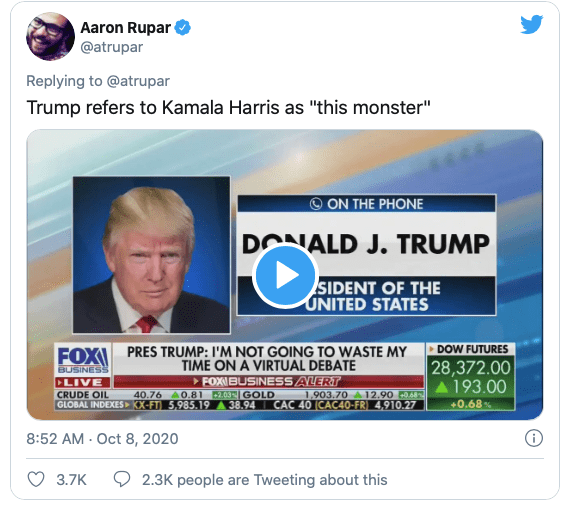
After the vice presidential debate, President Trump visited Fox News to give his review of the senator’s performance.

“Totally unlikable,” he said during an interview on Fox Business. He also referred to her as a “monster,” twice during the interview. 

Aaron Rupar on Twitter @atrupar

In a tweet, Senator Chuck Grassley, a Republican senator from Iowa, stated that he would prefer to have dinner with Vice President Mike Pence, since he was more likeable in Grassley’s view than Senator Harris. 

Chuck Grassley on Twitter @ChuckGrassley

For many women in professional settings, Harris’s situation during the debate was a familiar one. She was forced to listen to Pence as he interrupted her and lied during the debate. Harris also had to carefully articulate her words and emotions in order to be perceived positively. She had to come off as strong, but not aggressive, and display her emotions in a way that made her seem human, but not as hysterical. Many women in the corporate world face situations like this everyday with their male colleagues. 

Women should not be attacked for aspects of themselves that they cannot control. Female politicians should not be criticized for how they dress, their tone of voice or whether or not they are competent enough to do the job. Instead, we should be having a conversation about the policies that they stand for or the positions that they are taking. 

So how can we end this question of likability with female politicians? For one, reporters and the media can stop asking female politicians sexist questions or writing articles about how they dress. If the media does not fuel the conversation for female candidates being too cold or elitist, the public will talk less about it. The conversation can be shifted to policy issues and matters that affect Americans. People can begin discussing the female candidates stances on climate change, or healthcare rather than the appearance of these candidates. 

Criticize female candidates for their policy positions, but do not criticize them for being likable enough. 

Young People are Voting

Image by Paul Brennan from Pixabay 

Will this year be the year that young Americans turn out to vote in record numbers? Based on current early voting trends, it looks like it will be. 

According to a Harvard Youth Poll conducted in September, 63% of Americans 18-29, said that they will definitely be voting in the presidential election this year. In the 2016 election, number number of young Americans who would definitely be voting in the election was at 47%; 16 percentage points fewer. 

Enthusiasm is also high among younger voters. In a new CNN poll, 51% of registered voters 18-34 say they are extremely or very enthusiastic about voting in the 2020 presidential election. Voter enthusiasm does not necessarily correlate to higher turnout, but it is a good sign that voters will cast their ballots.

There is also evidence based on the 2018 midterm elections that younger voters will turn out in great margins to vote this year. According to a Pew Research Center Survey, millennial voter turnout almost doubled from the 2014 to the 2018 in the midterm elections. They went from 22% to 44% in 2014 and 2018 respectively.

Major social movements in the last few years have driven younger people to actively participate in politics. Protests and movements such as the Women’s March, Black Lives Matter, climate change and gun safety, have all led younger Americans to be more engaged in politics and policy. The outcomes of these movements will impact younger Americans for generations to come, and these voters want their voices heard.

Early voter turnout in many states suggests that young people will break voting records in the 2020 election. According to the Democratic data firm, TartgetSmart, more than 6.8 million people ages 18-29 had voted early or by mail in the election by midweek this week. This is a major increase from the 2016 election of early voting among young voters. 

Texas is known for having low rates for voting in previous elections, but this year things are different. According to TargetSmart, by midweek, voters under 30 had cast more than 900,000 ballots in Texas. This is nearly three times the number it was in 2016. Texas had 8.2 million total votes on Wednesday, and the number has continued to increase during the week. These 8.2 million votes are 91% of the votes placed in the 2016 election. Texas has also added 1.9 million voters since 2016, mostly younger and Latino voters who may lean Democratic. 

In previous years, younger voters have voted at low rates. Organizations such as When We All Vote and Vote Save America, have been working extra hard this election season to meet young voters where they are. It is important to engage young people in the areas that they spend the most time, such as Twitter, Instagram and Snapchat. These organizations have created tools to register to vote, request absentee ballots, make a plan to vote and much more. 

The Biden campaign has definitely implemented the strategy of reaching young voters where they are. The campaign has invested money and time in online platforms, such as social media and gaming. 

This could be the year that young voters turn out to vote in historic numbers. It will all come down to Election Day.

Following the Election Night Returns

Photo by Element5 Digital on Pexels.com

Election Day? Election week? Election month? How long will it be until we find out who the next president is after Election Day?

In ordinary election years, media outlets are oftentimes able to call which candidate is going to win in many states on election night shortly after the polls close. A state is called by a major  media outlet when they believe a candidate has an unbeatable lead in the state and the other candidate is unable to surpass them in votes. This is a prediction though, and not a final result. The state will make a final call once all of the results are in. 

This year will be much different on election night. With many states primarily using mail in-voting and early voting, some states will not be called on Election Day. This could lead to a several day delay before Americans know who the next president is. Especially since several key battleground states will not begin counting ballots until Election Day. For example, Pennsylvania and Wisconsin have laws that prevent the processing of mail- in ballots until Election Day. 

The pandemic has also caused many states to quickly expand mail-in voting. This has resulted in slowdowns in counting ballots and organizing the results of the election. 

Based on the primaries in the spring and summer, it took some states several days to count all the votes and process who won. New York processed 94% of the ballots on primary day within a few hours of the polls closing. But counting the final six percent of votes took more than 10 days. There were many races that were too close to call and the winners remained unknown for several weeks. 

The three battleground states of Pennsylvania, Wisconsin and Georgia also took several days to release the results of the primaries in the state. These states will play a key role in the outcome of the election, and the likelihood that they will be called on election night is slim. 

The four important battleground states of Pennsylvania, Michigan, Wisconsin and North Carolina have tentatively extended the deadline that mail-in ballots can be received by. These changes may impact when Americans will know who the president is. Recently, the Pennsylvania Supreme Court, ruled that ballots can arrive by November 6th, and be counted as long as they are postmarked by Election Day. In Michigan, ballots can be counted as long as they are postmarked by November 2nd and received by November 17. In Wisconsin, ballots can be counted that are postmarked by November 3rd, and arrive by November 9th. Finally, North Carolina reached a tentative court agreement that would allow ballots to be processed as long as they are postmarked by November 3rd, and arrive by November 12th. 

The decisions out of these states are not final and can still be overruled. But, if these rules are enforced by Election Day, it will make it easier to vote by mail-in these states, and ballots will continue to come in after Election Day. Media outlets also will most likely be unable to declare a winner in these four states on election night. According to FiveThirtyEight’s presidential forecast, there’s a 56% chance that one of these states will decide the presidency. If these states are not called on election night, the presidency will not be called either

Despite this, 80% of Americans plan to follow the results of the presidential election after the polls close on Election Day very closely or fairly closely. Americans still plan on keeping up with the results, even if the president is not known by the end of the night. By candidate support, 62% of Biden supporters, and 59% of Trump supporters plan on following the results of the presidential election after polls close on Election Day very closely. 

Where will Americans be following the results of the election? Most adults, 60%, say they will follow the results on a major national TV network, such as ABC, NBC and CBS. Some are also planning on following the results using social media, with 42% who plan to follow the results that way. 

Americans are also largely confident that the news sources  they follow will make the right call on election night, with 82% of Americans having a lot or some confidence in the news sources to announce the correct winner. 

There will be more absentee and mail-in ballots than in previous elections, and it will take longer to count them. It is important not to rush to call the election on election night, since it will take more time to count the votes. Americans will need to have patience, and confidence in the electoral process.

Voter Turnout 2020

Photo by Element5 Digital on Pexels.com

With less than three weeks until Election Day, early voting has already started in many states across the country, crushing 2016 levels.  

It has been one of the most challenging election years in the United States. The Coronavirus pandemic has changed normal voting procedures, and the expansion of mail in voting has not met the demand needed in some states. Lines that are hours long have formed at many polling stations in Texas and Georgia, but people are determined to cast their ballots. 

According to the US Elections Project, as of this Tuesday morning, 10.6 million voters across the United States have casted their ballots for president in the upcoming election. This is a significant increase from early voting levels in 2016. By October 16 in 2016, only 1.4 million voters had cast a ballot. 

In Texas, early voting began earlier this week. Voters arrived at polling sites to find long lines and wait times to cast their ballots. A record number of voters cast their ballot in one of Texas’ most populated counties. On the first day of early voting, 128,000 people voted in Harris County, according to the county elections office. This was a major increase compared to the first day of voting in 2016, when around 68,000 people voted in that county. This could be due to changes in voting procedures brought on by the pandemic, or overall increases in enthusiasm towards this election. 

According to a recent Gallup Poll, 74% of Americans have given “quite a lot of thought” about the upcoming election for president. This is the highest percentage of Americans who have given quite a lot of thought about the presidential election since 2008 when the percentage was at 80. Americans have paid closer attention to this race, and thought carefully about who they are voting for. Also included in this poll, 67% of Americans are more enthusiastic than usual about voting, compared to previous elections. In the party breakdown, 80% of Democrats are more enthusiastic about voting this year, while 75% of Republicans are. Voters are eager to make their voices heard and are voting early. 

The level of enthusiasm for this year’s election, and the amount of thought given to it could contribute to the level of importance that Americans view the election. According to a Pew Research Center survey conducted in August, more voters say “it really matters who wins the presidency” than at any point in the last 20 years. Even in 2016, voters did not say that it mattered as much as it does this year who wins the presidency. Pew found that 83% of respondents said that it really matters who wins the presidential election in November. Americans are voting early and in high numbers because they believe that this election is incredibly important. 

The 2020 presidential election may be the most important election in our lifetimes. The increase in early voting, level of enthusiasm, and perception of importance all play a role in the outcome of the election.